Human Sensing
Image-based measurement of the human body and vital signs for medical, welfare, and health applications.
COMPUTATIONAL SENSING / 3D VISION / BIOMEDICAL ENGINEERING
Through 3D sensing, image recognition, and AI,
we explore new ways to measure people, environments, and agriculture.
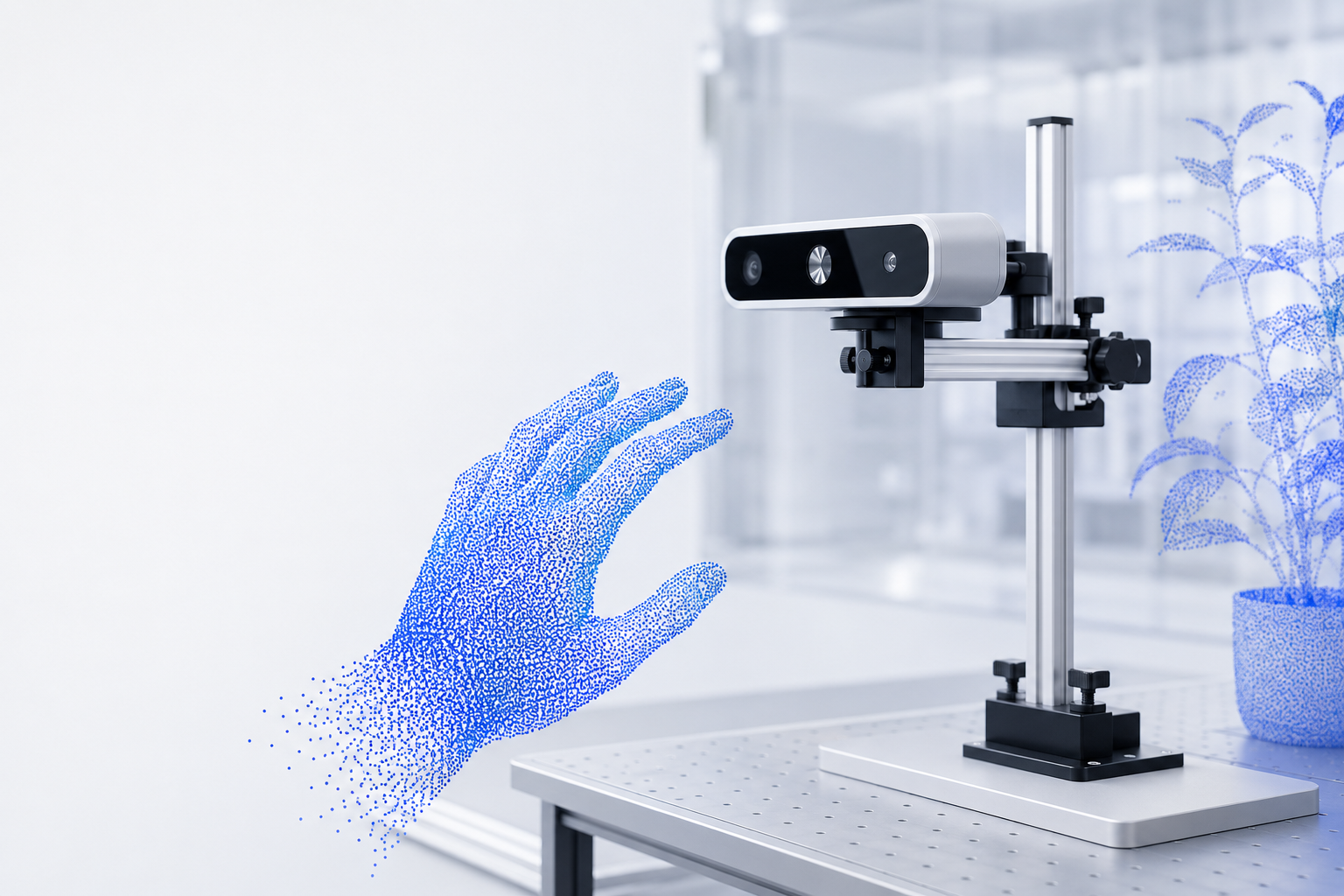
Image-based measurement of the human body and vital signs for medical, welfare, and health applications.
Human–machine interaction and the relationship between art and technology.
Image-sensing systems for smart agriculture and artificial-light plant factories.
Aoki Laboratory conducts research in image engineering, biomedical engineering, welfare engineering, sports engineering, and art that uses technology.
With the goal of turning research outcomes into social contribution, we pursue themes with practical application in mind and actively collaborate with universities, medical institutions, companies, and research institutes.
From minute signs of life and plant growth
to human perception and expression.
We use 3D image sensors to extract subtle respiratory motion from large body movements such as pedaling, and explore pulmonary-function testing that avoids contact with equipment.
Joint research with Hokkaido University Hospital, Saitama Medical University, and local companiesMinute cardiac motion appearing on the chest wall is measured and visualized without contact, enabling us to explore ways of seeing the state of the heart alongside auscultation and palpation.
Joint research with Tokyo Women's Medical University and The Jikei UniversityWe quantify plant growth through 3D imaging, transforming field observations into reproducible numerical information.
Featured on TV Hokkaido (TVh)A haptic device conveys an instructor's motion and the minute force at the brush tip, supporting the embodied acquisition of calligraphy skills.
Featured on NHK BSWe create and exhibit artworks that respond to people and space by applying 3D imaging and LED lighting.
Exhibited at Sapporo Cultural Arts Community Center SCARTSWe develop interfaces that use vision and human perception to create sensations of weight or lightness without applying mechanical force.
Turning perception into human-centered technologyEST. 2013.07
Since the laboratory was established in July 2013, we have steadily built research achievements together with our students. We value crossing disciplinary boundaries to create technologies that truly work in the field.
LABORATORY DIRECTOR
Professor, Department of Electro-Optical Engineering
Chitose University of Science and Technology, PhD (Engineering)
COLLABORATION / STUDY / RESEARCH
For research collaboration, graduate study, or questions about our work, please contact us at the address below.
